Corporations have long enjoyed creating toothless “self-regulatory” regimes that exist primarily to pre-empt real government oversight. While the quality of these orgs can vary somewhat, generally they’re just a toothless pantomime designed to pretend that corporate power can effectively police itself for ethical and competitive breaches. U.S. history has a thing or two to say on their real-world effectiveness.
This week, Trump met with most of the major tech industry AI leaders, who once again demonstrated they’re enthusiastic supporters of the most corrupt and autocratic administration in U.S. history (they’ll then turn around with puzzlement at why the public might be hostile to their products).
They met, in part, to celebrate two very silly things. One, the president’s random decision to arbitrarily try to rename AI as “superintelligence” via executive order. And to announce they’d all struck a completely voluntary agreement to try and maybe do better when it comes to developing software automation responsibly, securely, and ethically.
Basically, our richest tech titans wanted to help Trump pretend he’s competent and powerful, and stall any real public interest accountability, whether it’s for the environmental impact of data center turbines on marginalized populations, the sloppy failure to secure their own automated hacking software, or their reckless and comical disregard for U.S. consumer privacy.
The 308-word “AI accord” is a load of bullshit and fluff. One, it’s worth noting it couldn’t even spell “United States” properly. Two, most of it is just vaguely urging AI companies to do things they were already doing (poorly), such as this recommendation:
“Empower an internal team to ensure all of the controls, monitoring, and detection are operating as intended, and that any issues are remediated.”
Why hadn’t anybody thought of that?
Or this one:
“Implement robust internal controls to monitor the capabilities and alignment of its models during training and deployment around areas like cybersecurity, biosecurity, and chemical threats, and to ensure that its models do not hack or access technical systems in unintended ways.”
To be clear, several of the high-profile agentic AI hacks in recent months attributed to doomsday sentience were in reality just big and unethical companies simply failing to do very basic things: like confirming third-party vendors had adequately isolated their automated hacking software from the internet, or failing to monitor their automatic hacking software in real time.
Of course they’re not doing a great job on this sort of thing because they’re all hungrily eyeing multi-trillion dollar IPOs based largely on fraudulent accounting and are in a mad dash toward the trough. They’re also not doing a better job because they know their support for a corrupt autocrat also involves him defanging corporate oversight and the regulatory state, ensuring no real penalties or liability.
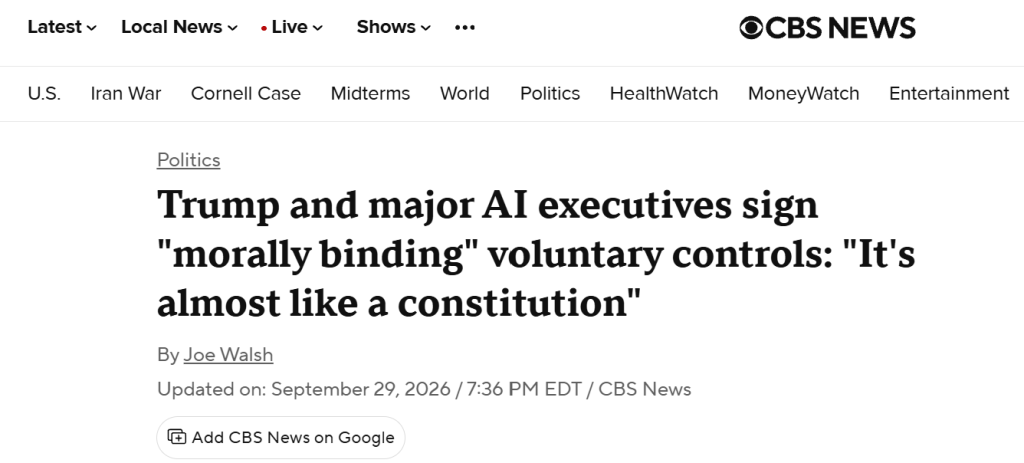
Politely recommending that big corporations with more money than sense try to do a better job on quality control, privacy, and security isn’t actually accomplishing anything. None of the requests are actually real things, despite Trump comically trying to insist they were “morally binding.”
Down at the bottom of the document, it insists that “over time, it may make sense to codify these steps into laws or regulations.” That’s particularly amusing given that Congress is currently too corrupt to function, and the Trump administration has taken an absolute hatchet to already shaky U.S. consumer protection, corporate oversight, and regulatory independence.
Most of the corporate media coverage of the AI announcement was negligently shallow (see: Reuters, Politico, Axios), not only failing to point out that the AI accord was meaningless, but that Trump has actively defanged all of the federal government oversight systems you might otherwise lean on to hold these companies accountable down the road.
You can wind your way through this whole Reuters story, for example, without the slightest hint that this proposal might not be a real boy. Or that Trump clearly, indisputably remains overtly hostile to corporate accountability or public interest guardrails of any meaningful kind. Most of our big news outlets simply put the lies right in the headline, completely unchallenged.

It’s “almost like a constitution,” guys!
Here in reality, Trump’s captured Supreme Court has actively ensured that any regulator that tries to hold companies accountable for literally anything will find themselves swatted on the nose for exceeding their regulatory authority. This administration has ensured that already shaky corporate oversight no longer functions — and our corporate press doesn’t think that’s useful context worth mentioning.
They’ve all adopted the Libertarian and corporate Republican framing that government regulation exists exclusively to “stifle innovation” and ruin everybody’s good time. And that corporate pinky swearing has real worth when it comes to environmental, labor, and consumer protection law, despite a generation of very ugly and indisputable evidence to the contrary.
If AI regulation does come in the new year, it will most likely be written by the biggest tech companies with an eye on legalizing all their worst impulses, banning Chinese AI (to “protect U.S. consumer privacy and national security), and box out open source, on-device, open-weighted, or other competitive threats to the biggest companies’ cloud-software walled-garden domination.
The corruption and regulatory capture are disgusting enough, but it’s positively grotesque that the U.S. lacks an establishment press that’s capable of explaining any of this to the public at large.