Sometimes it helps to just write out everything that happened leading up to a situation so we don’t lose sight of just how ridiculous it is.
I mean, would you believe that a President would sue his own IRS for something that happened under his own watch and did him no harm, demand $10 billion, and when a judge calls into question how that’s possible, come up with a “settlement” between the two “parties” that grants himself, his family, and his far-flung businesses (already under investigation for tax fraud) a complete get-out-of-jail-free card from tax audits along with a special $1.776 billion slush fund which he can hand out to insurrectionists who tried to overturn an election he had lost?
And then, his Acting Attorney General seeking the permanent job (who had been the President’s personal lawyer in early criminal cases, including one where the President was convicted of 34 felonies), would tell inquiring Senators that the slush fund wasn’t moving forward, but refuse to put that in writing?
When you write it all out that way, it sounds kinda crazy.
Last month Judge Kathleen Williams nuked the fund and alerted various state bars to the ethical lapses of all the government lawyers involved, including Todd Blanche, the President’s personal criminal defense lawyer-turned Acting Attorney General-turned nominee for the permanent Attorney General position.
Blanche’s nomination had stalled out, in part because two Republican Senators (Cornyn and Tillis, both of whom are leaving office after Trump refused to support their attempts to stay) have questioned the slush fund. Blanche refused to put it in writing that the fund was going away, leading to this strained exchange with Cornyn:
Republican Sen. John Cornyn of Texas, reading from the settlement on Wednesday, noted that it says the terms of the deal “may be modified only upon the written agreement of the parties.”
“Has there been a written agreement of the parties to modify the settlement fund?” he asked.
“No, the settlement fund is just not moving forward,” Blanche responded. “There’s no modification. It never started. No money went from the Treasury to any other account.”
When pressed, however, as to whether the settlement agreement may be enforceable by the parties, Blanche conceded that the president could challenge it down the road.
“Yes, it’s an enforceable document, so I suppose if President Trump’s counsel sought to enforce it, that they potentially could … try to enforce the contract. They can’t force the Department of Justice to move forward with the weaponization fund. They could potentially say that we breached by not moving forward,” Blanche said. “They haven’t done that, and I’m not aware that they’re planning on doing that.”
Given all of that, you would think that, perhaps, Trump wouldn’t make any public effort to say that the fund should still exist.
But, again, we live in the upside down world, where if Donald Trump wants something, he just throws a temper tantrum until he gets it. Three new developments have happened regarding all this in the past few days.
First, on Friday, Donald Trump appealed Williams’ order and filed a long, rambling motion about how unfair the order was. That doesn’t sound like someone who is willing to accept that the fund is dead. Second, on Saturday, Trump posted a rant to his personal social media site about how mad he was at Cornyn and Tillis, and how he still needed the fund, and even hoped Congress would pass a separate law giving him the slush fund. Finally, despite these two things making it abundantly clear that Trump still plans to create a slush fund for his cosplay militia, on Sunday, Blanche finally signed a letter claiming the slush fund was dead.
Let’s take these each in order.
First the appeal and the whiny motion about it. The most incredible thing about it is that, even though it was filed by lawyers hired by Donald Trump (the person), as I was reading it, it read like it was filed by the Justice Department. Remember, the entire reason that Williams killed the “settlement” of Trump’s lawsuit against his own IRS was that there appeared to be no adversarial parties in the case, and it was just Donald Trump suing himself in order to give the “settlement” the stamp of authenticity that it was part of a federal case.
While, to their credit, this new filing at least brings in real lawyers from an actual serious law firm, DLA Piper, alongside Trump’s original two-bit lawyer Alejandro Brito, the argument itself is still a mess. Again, you could totally picture either Donald Trump or his DOJ/IRS filing this since the original ruling applies to both. Because they’re not adverse parties. They’re all on the same side.
The ruling rests on a grievous legal error: that, because President Trump supervises the Executive Branch, he and the United States necessarily possess the same legal interest and cannot be adverse to each other. That is wrong. President Trump asserted a personal claim arising from the theft of his own tax information. The IRS and the U.S. Department of the Treasury (“Treasury”) represented the sovereign’s interests in public funds and federal law. Donald Trump Jr., Eric Trump, and The Trump Organization asserted their own independent claims. Presidential supervision did not erase those rights or merge those interests.
The Sanctions Order nevertheless erroneously treated its novel theory of adversity as the starting point and then refracted the facts through that mistaken lens. Settlement became proof of collusion, even though there was none, potential (weak) defenses became proof that the claims were fictitious, which they were not, and ordinary professional relationships became proof of coordination, which did not exist. But the Sanctions Order identified no pre-filing sub rosa agreement, no false allegation, and no specific direction by President Trump controlling Defendants’ litigation decisions. The predicate legal error thus supplied the conclusion, causing the Sanctions Order to incorrectly recast entirely innocuous facts as misconduct.
The danger posed by the Sanctions Order is profound. The Court called the Article III question “unprecedented,” appointed six amici, and devoted nearly thirty pages to resolving it— yet it then declared the contrary position “so obvious and so insurmountable” that advancing it warranted career-altering sanctions. Id. at 9-38, 53 n.69. That mistake converts disagreement into professional punishment, and strikes at the integrity of the adjudicative process itself. A system that sanctions lawyers for advancing positions on constitutional questions cannot sustain fearless advocacy or principled legal development.
Note the tell in that last bit: the “professional punishment” landed on both sides — Trump’s lawyers and the government’s — which is exactly the point Williams was making. And, yes, courts are historically reluctant to sanction lawyers at all. But that reluctance is the problem, not evidence that the one judge willing to do it got it wrong.
As for the claims that the DOJ was actually representing the IRS’s best interests, and not Donald Trump’s, that’s belied by quotes from Donald Trump himself — who publicly admitted he was negotiating with himself — and the terms of the “settlement” which make no sense and do nothing to support the interests of the IRS, the public, or the American taxpayer. If this case was actually about Trump’s leaked tax returns, how does giving the family a release from tax audits or handing over nearly $2 billion to insurrectionists (wholly unrelated to this suit) have any of the American people’s interests in mind?
The strongest argument this filing has is that one part of the ruling is arguably prior restraint. To make sure that the settlement agreement for the slush fund was not used for improper enrichment, Judge Williams barred the parties from invoking the settlement in other proceedings. Trump’s new lawyers say that this part is prior restraint:
In addition, Rule 11 and inherent authority cannot support an order forbidding the President, private Plaintiffs, federal agencies, and sweeping categories of associated persons from “referring to” the Settlement Agreement or invoking it in any future judicial, administrative, regulatory, arbitral, or other official proceeding. D.E.106 at 47. That unprecedented injunction regulates future speech and advocacy, is unconstitutional, and is patently unlawful.
The Sanctions Order’s command is a content-based prior restraint. It singles out one subject—the Settlement Agreement—and suppresses one message, i.e., that the Settlement Agreement exists and may carry legal effect. Prior restraints carry a “heavy presumption” of constitutional invalidity, Bantam Books, Inc. v. Sullivan, 372 U.S. 58, 70 (1963), and constitute “the most serious and the least tolerable infringement on First Amendment rights.” Nebraska Press Ass’n v. Stuart, 427 U.S. 539, 559 (1976). They require findings that the threatened harm is “both great and certain and cannot be mitigated by less intrusive measures.” CBS, Inc. v. Davis, 510 U.S. 1315, 1317 (1994) (Blackmun, J., in chambers). The Sanctions Order identified no threatened unlawful speech, no resulting harm, and no reason narrower relief would be inadequate. Indeed, it did not address the First Amendment at all.
And while this is the strongest argument, that doesn’t make it actually strong. The order does not stop Trump or his lawyers from talking about the settlement. They can post about it on Truth Social, complain about it on Fox, write a book about it. What they can’t do is walk into another court, agency, or arbitration and invoke a settlement that a federal judge just voided due to the lack of adverse parties. The only “speech” being restrained is further fraud on the court.
But the fact that Trump bothered to make this argument at all is the real tell. You don’t fight for the right to invoke a settlement in future proceedings unless you’re planning to invoke it in future proceedings — which is precisely what Blanche has spent months assuring senators would never happen.
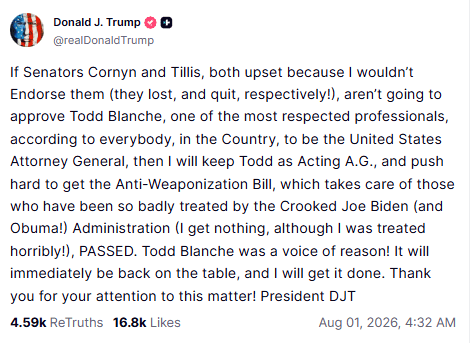
Then, even as Blanche was negotiating with Cornyn and Tillis to get them to vote in favor of his AG nomination by promising not to create the fund, on Saturday, Trump said hell yes he intends to make use of the fund — and added that he’d like Congress to pass a law establishing the same fund as a backup, in case the courts kill the one he negotiated with himself:

That’s a Trump post on Truth Social saying:
If Senators Cornyn and Tillis, both upset because I wouldn’t Endorse them (they lost, and quit, respectively!), aren’t going to approve Todd Blanche, one of the most respected professionals, according to everybody, in the Country, to be the United States Attorney General, then I will keep Todd as Acting A.G., and push hard to get the Anti-Weaponization Bill, which takes care of those who have been so badly treated by the Crooked Joe Biden (and Obuma!) Administration (I get nothing, although I was treated horribly!), PASSED. Todd Blanche was a voice of reason! It will immediately be back on the table, and I will get it done. Thank you for your attention to this matter! President DJT
Once again, Trump’s ability to shoot his allies in the back remains undefeated. Cornyn (especially) and Tillis have said that their hesitancy in approving Blanche had a lot to do with the weaponization fund. Blanche’s approval appeared contingent on a theatrical claim that the fund wasn’t going forward. To have Trump then come out and say “hell yes it’s going forward, even over the objections of Cornyn & Tillis” seems unlikely to appease those two Senators.
Tillis, for one, was not impressed:

That’s Tillis tweeting:
Despite comments as late as yesterday that the fund is dead, President Trump clearly intends to resurrect the payout pot for punks either by inappropriately establishing another bogus fund or pushing Congress to vote for a bill that the majority of Republicans in the Senate would be against.
It’s unfortunate that Todd Blanche, who I consider qualified for the job, will not be confirmed because of this reversal. Hopefully, we can resolve this by Tuesday.
It’s been quite clear that Trump has no intention of ever letting go of this slush fund, but it’s classic Trump that he couldn’t even keep his mouth shut long enough to pretend the fund wasn’t going forward and to get Blanche approved.
Which then brings us to the last bit that came out late Sunday: Blanche tweeting out that the DOJ had finally decided to “rescind” the weaponization fund in writing. Something he had refused to do over the past few weeks.

There are two separate letters there. The first “rescinds” the fund, while making an obnoxious snarky comment about “frivolous lawsuits” filed to challenge it:
A. The Attomey General’s May 18, 2026 Order establishing the Anti-Weaponization Fund (“Fund”) is rescinded and shall have no force or effect.
B. For the avoidance of doubt, nothing in this Order is intended to contradict or otherwise be contrary to prior representations by the Department of Justice that the Fund is not operative. No Members were appointed; no funds were transferred; no process for receiving claims was established; no claims were paid. Nevertheless, several frivolous lawsuits have been filed challenging the Fund, and at least one court has declined to dismiss those claims as moot. This Order establishes, beyond any doubt, that there is no Fund…
If the cases were “frivolous” then why would you need to rescind the agreement?
The second, with snide shots at Congress for not believing his statements, says a bit more on the matter:
Department of Justice Rescinds Anti-Weaponization Order and Addresses the May 19 Release
The Department of Justice today announced that the Acting Attorney General rescinded the May 18, 2026 Order that established “The Anti-Weaponization Fund.” Although the Acting Attorney General has repeatedly advised Congress through testimony, including under oath, as well as in written responses, that the Fund is not moving forward, and the Department has repeatedly represented to district courts that the Fund is not moving forward, today’s Order officially rescinds the May 18, 2026 Order.
Further, the May 19, 2026 Order regarding a mutual release of claims applies by its terms only retroactively. Additionally, the terms “Lawfare and/or Weaponization” in that Order were already defined in the Settlement Agreement as the use of government power “to target individuals, groups, and entities for improper and unlawful political, personal, and/or ideological reasons.”
The Acting Attorney General stands by all of his July 15, 2026 Senate Judiciary Committee testimony, including answers to questions asked by Senator Cornyn related to the scope and applicability of the May 19, 2026 Order. A transcript of the Acting Attorney General’s testimony is attached. He incorporates that testimony by reference, and restates that it is DOJ’s interpretation that the Order only has any effect, including on any release of claims, on the named parties in the lawsuit referenced in the Order.
This all seems pretty obviously designed to get Cornyn and Tillis off his back by saying “see?!? I’ve now put it in writing. Now shut up and vote to make me Attorney General.” And, who knows, it might work.
That’s even though nothing in there actually answers Cornyn’s actual question discussed above. The DOJ cannot single-handedly go back on this agreement. It was, we are told (including in the appeal from Trump on Friday), a private agreement between two distinct parties: Donald Trump and the Justice Department. As such “rescinding” it from just the DOJ side is meaningless since, as Blanche himself admitted to Cornyn, Trump can still try to claim in court that the settlement is valid.
And given Trump’s public statements about why he needs the fund, as well as his lawyers’ statement in the appeal that it tramples his rights to order him not to claim the settlement is valid in court… you’d have to be pretty slow not to pick up on what Trump intends here.
Also, notice what didn’t get rescinded. The May 18th order (creating the slush fund) is what he pretends is gone, but the May 19th order, which clears Trump, his family, and their businesses from IRS audits over past business practices remains. Blanche pretends that saying it “applies by its terms only retroactively” is a meaningful limitation, but that was always obviously the case. By all accounts, the Trump family books are a mess, and they likely owe the IRS a ton of money. And the Blanche announcement makes it clear that remains as is.
So, to sum it all up, Blanche has rescinded an order based on a settlement he can’t single-handedly rescind, to appease Senators whose votes he needs, while the President has made it clear he’s going to move forward with his fund no matter what.
The simple reality here is that we have a crooked President with his hand-picked henchman trying to do the bare minimum to appease a compliant GOP-run Senate, while the President himself can’t keep his own mouth shut long enough to even put up the pretend facade that there’s no corruption going on here.
Under any other President, this would be an impeachable offense. Here it was just another weekend under the Trump Presidency.