Last year you might recall how Elon Musk’s far right wing extremism (and endlessly incoherent behavior) had many countries reconsidering their use of his low-Earth orbit satellite company, Starlink. It was driven by the fact that Musk had restricted Ukraine’s access to the service near Crimea because he personally opposed Ukraine’s military aims (defending itself from unprovoked invasion by authoritarians).
Competitors are lagging behind SpaceX on LEO satellites, though the events prompted Germany to help fund Ukraine’s use of alternative fledgling LEO satellite communications options, including Eutelsat. Other competitors, including Jeff Bezos’ Leo, should make market inroads over the next few years, but most deployments are far behind Starlink’s 11,150 orbiting LEO satellites.
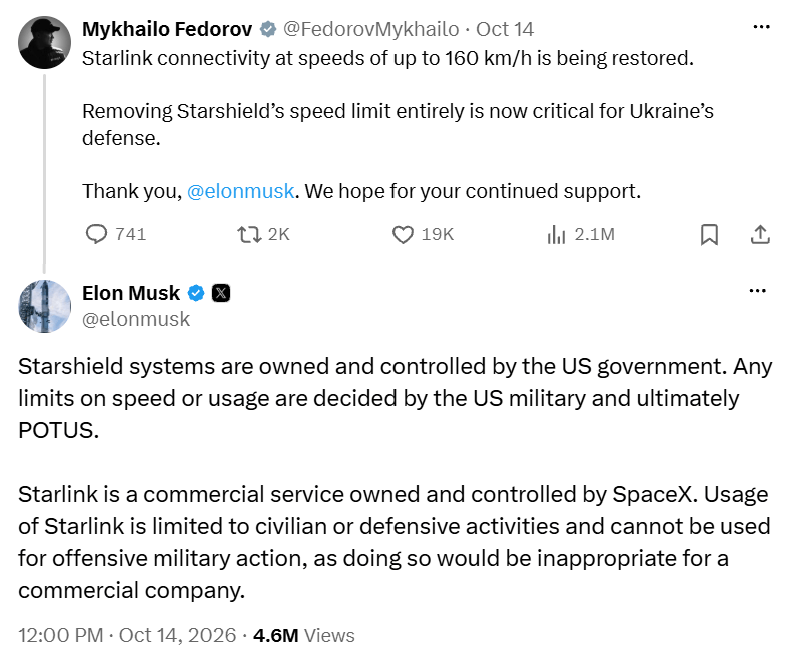
Now the problem has popped up again, this time with a Wall Street Journal report that Musk pressured the Trump administration to throttle Ukraine’s Starshield (the military version of Starlink), undermining Ukraine’s ability to communicate and engage in military drone operations.
Musk is a cornerstone of a well-funded global authoritarian alliance and, like Trump, wants global authoritarians to succeed. Both Trump and Musk are upset with Ukraine’s efforts to target Russian oil production facilities (in part because even higher domestic gas prices threaten Republican midterm success, and the success of Musk’s unrelenting assault on democracy and foundational civil rights):
“Both Musk and President Trump have expressed anger at Ukraine for attacking Russian diesel refineries in recent weeks, which the president blames for high energy prices. Last week, Musk capped the speeds at which Ukrainian hardware could stay connected to the satellite-based network, the people said, rendering some offensive drones and interceptor drones virtually useless.”
Just a week earlier both Trump and Musk vacillated between pretending they didn’t know what was happening — to each trying to blame the other for the slowdowns, with Reuters originally insisting that the order to throttle Ukraine’s Starlink connections “came from the White House.”
Regular Starlink terminals have automatic network throttling protection if a connected vehicle operates in excess of 70 km/hr. Starshield, in contrast, is supposed to have no cap, but has been throttled if drones or vehicles exceed speeds of 90 km/hr. The throttling reduced Ukraine’s ability to use the network for both offensive and defensive drone operations, causing “tens of millions of dollars in losses,” Ukraine officials said.
At his right wing propaganda website formerly known as Twitter, Musk also tried to claim the order came from the White House:

But the Wall Street Journal’s reporting indicate that many sources believe the decision to throttle Ukraine’s connectivity ultimately came from Musk himself:
“During the uproar, SpaceX representatives called White House counterparts seeking a unified understanding and subsequent message that the company and Trump administration coordinated ahead of Musk’s directive, the people said.
Some U.S. officials say that Musk acted unilaterally and that Trump didn’t specifically order any retribution against Ukraine. But a person familiar with the situation said Musk talked to multiple senior administration officials, including with Trump, before imposing the new speed cap, which Ukrainian officials said had allowed Russian missiles to evade their defenses.”
Trump has repeatedly feigned ignorance, as recently as Monday insisting “I don’t know who it was, but I’d like to find out.” The stage play is for the benefit of the dwindling number of Reagan-era Republicans who (correctly) find a U.S. alliance with Putin to be traitorous. Secretary of Defense head Pete Hegseth tried to falsely claim that Ukraine somehow violated Starlink’s terms of service:
“We haven’t pulled anything back. There are terms of service that ultimately need to be complied to. And that’s where Starlink has the option to make those decisions, but nothing’s changed from our view. We haven’t made any directives or anything like that,” Hegseth told reporters, adding that “we wish the Ukrainians, obviously, success.”
U.S. Secretary of State Marco Rubio also issued statements implying that the White House wasn’t fully informed about Musk’s decision to unilaterally imperil Ukraine’s military operations. He also claimed that unilaterally harming U.S. ally military operations is apparently a decision for Elon Musk, not the White House, if you needed further evidence of just how comically corrupt the U.S. has become.
Ukraine says their satellite connectivity is still throttled, imperiling operations.
Ukraine’s relationship with Trump has soured (further) in recent weeks after the White House temporarily suspended intelligence sharing with Ukraine. Trump’s also been broadly criticized for suspending Russia sanctions and greenlighting diesel imports from Moscow, something he apparently hoped would lower U.S. gas prices and save him from an expected midterm lashing for Republicans.
Obviously the world’s richest man, and Trump’s biggest billionaire donor, unilaterally making decisions that prevent a U.S. ally from defending itself from authoritarian aggression is positively grotesque. As is the non-transparent game of patty cake and finger pointing in the wake of the decision. As is any telecom provider leveraging its monopoly to exert this level of political control.
Musk’s decision to arbitrarily throttle Ukraine’s Starlink usage appears largely to be an act of ideological and financial self-interest. Higher gas prices mean midterm trouble for Musk’s preferred global ideology (authoritarianism dictated by the whims of mad oligarchs). Trump and Musk are also trying to drive Kyiv to the negotiations table with an eye on ceding significant territorial control to Putin.
Republican control of the White House has been immeasurably valuable for Musk. Not only is Starlink now tightly woven to military operations and funding, but a Republican rewrite of the 2021 infrastructure bill is driving what could be billions in taxpayer subsidies into the back pocket of the billionaire for Starlink service he had already planned to deploy without subsidization.
You’d like to think that future U.S. administrations realize that Musk is a very clear national security threat and act accordingly. You’d also like to think Musk’s extremism drives the evolution of more robust competition in the fledgling LEO satellite space. Preferably before Musk’s global authoritarian alliance completely dismantles what’s left of representative democracy worldwide.