Atlanta, Georgia’s attempt to erect a law enforcement officer training center in Atlanta was met by months of concerted protests. As the months stretched into years (the center was announced in 2021 but did not complete construction until 2025), opposition efforts ranged from peaceful protests to heated exchanges during public comment sessions to attacks on construction equipment by people seeking to shut the project down.
The government has been pursuing criminal charges against protesters since 2023 — efforts that included the state of Georgia ringing up 61 protesters on RICO charges. That case stalled out last spring, but both state and federal prosecutors are still hoping to ring up a few headline-making arrests that might make it easier to depict anti-government protests as terrorism when engaging in prosecutions.
The desire to turn protesters into terrorists is generating collateral damage. With the prosecution of Cop City protester Sam Tunick, the federal government is apparently hoping to convert a cell phone operating system into de facto evidence of criminal intent.
Here’s how this fucked up turn of events began:
Sam Tunick was stopped for interrogation at Atlanta’s Hartsfield-Jackson airport on 24 January last year, after vacationing in the Dominican Republic. Unbeknown to him, federal authorities had put him on a terrorism watchlist because of his alleged association with the movement against Cop City.
What happened next was even more fucked up (from Tunick’s motion to suppress evidence):
The two CBP officers conducting the initial interrogation of Mr. Tunick never read him his Miranda rights and, further, Mr. Tunick stated early in the interview that he did not want to continue speaking without a lawyer. Yet the officers repeatedly ignored Mr. Tunick’s requests to speak with his lawyer, continued to question him, and declared: “because you’re refusing to talk, which is your right, we have the authority to go through your phone to see what we’re looking for.” [Timestamp 20:00:40].
After the officers requested Mr. Tunick’s cell phone password a second time, Mr. Tunick asked again why he was not allowed to call his lawyer, and the officers responded: “when it comes to immigration and customs, right, it’s a whole different ballgame. . . and we have search authority, we don’t need a warrant.” [Timestamp 20:05:09].
The CBP officers explained that Mr. Tunick would have to give the officers access to his phone, whether it was done with his cooperation or not and, eventually, Mr. Tunick provided a password to his cell phone and e-reader.
Also this:
The interrogation, including the questions about child sexual abuse images, was “a pretext for a fishing expedition into Mr Tunick’s connections” to the movement against Cop City, according to the motion.
The officers made it clear they would either seize Tunick’s phone or return it to him after they’d searched with the aid of his provided passcode. Either way, the officers were going to search his phone.
So, Tunick gave the officers what they asked for: a passcode. And then this happened:
Agent Findley and several others repeatedly asked Tunick to open his phone during the interrogation, telling him they would seize it if he did not. When he finally provided a passcode, “the screen went blank, flashed several times and the phone appeared to restart”, according to the motion.
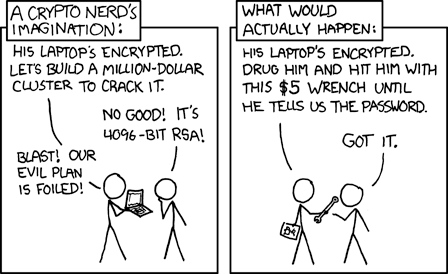
What the agents were witnessing (and were apparently unaware was a third option they hadn’t considered) was the triggering of cell phone operating system GrapheneOS responding to a “duress mode” passcode entry.
GrapheneOS users have this option…
GrapheneOS provides users with the ability to set a duress PIN/Password that will irreversibly wipe the device (along with any installed eSIMs) once entered anywhere where the device credentials are requested (on the lockscreen, along with any such prompt in the OS).
The wipe does not require a reboot and cannot be interrupted.
…which somewhat mitigates the deleterious effects of this government option:

Officers demanded a passcode. Tunick provided them with one.
This did not involve Tunick physically interacting with his phone at any time. And while we’re going to have to wait to see how this plays out in court, it seems like compliance (however malicious that compliance might be) is still compliance. It seems extremely vindictive to punish someone for the end result of the government’s actions.
At any point, the officers could have dropped the CSAM pretext and/or given Tunick access to his constitutional rights. Instead, the government leveraged its “Constitution-free zone” privileges in an attempt to intimidate someone into full cooperation, all while pretending this was about illicit images, rather than Tunick’s activism against the government.
And the government knows its case against Tunick is weak. It’s not charging him with destroying evidence or obstruction. Instead, it’s relying on a seldom-used statute that criminalizes destroying property the government wants to seize.
That is some weak sauce. But it’s the sauce the government wants to use. If the court allows this to proceed without suppression, the government will be allowed — and encouraged! — to consider the mere existence of GrapheneOS on a person’s phone as evidence of criminal intent.
“It’s concerning – and sends the message that [GrapheneOS] is criminal by default,” said Christophe Boutry, a cybersecurity and surveillance expert. Boutry and Bill Buddington, senior staff technologist at the Electronic Frontier Foundation, both said they had not seen a similar case.
This is the DOJ trying to open the Overton Window while simultaneously trying to convert a lot of protected speech into acts of terrorism.
I would hope the court rejects any counteroffers from the government. Agents demanded a passcode and a passcode was provided. That it didn’t provide them access to the phone’s contents is on them. And it’s pretty clear the government knows it barely has a case here. If it thought it could connect the legal dots convincingly, it would have gone for an obstruction charge, rather than the bullshit it’s pulling here. The government could still seize the “property.” That it now contains nothing it might use to generate more charges against Tunick is on the officers who decided to abuse the “border” privilege to cheat an American out of his constitutional rights while pretending to give a fuck about CSAM.