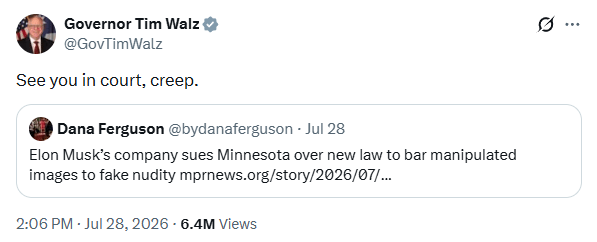
Last week we wrote about how Elon Musk’s xAI had filed a lawsuit to attempt to block Minnesota’s anti-nudify app law. As we tried to explain, even if you (reasonably, understandably) dislike both Elon and “nudify” apps, there were real problems with the Minnesota law. In particular, it was not narrowly tailored to just target truly harmful image edits. Indeed, it wasn’t even limited to the non-consensual use of the tech. The state’s Supreme Court had already handed the Minnesota legislature a clear roadmap for drafting a law like this that would pass strict scrutiny. The legislature ignored it.
However, the lawsuit was filed just days before the law was set to go into effect, which was called out by Minnesota’s Attorney General in arguing against a temporary restraining order:
First, X.AI’s lack of diligence confirms that a TRO is unnecessary. The company waited until the last minute to sue…
And that seemed to influence Judge Donovan Frank, who denied the motion for the TRO mainly because Elon waited until the last minute to file.
The Court respectfully denies the request for a temporary restraining order before tomorrow. xAI filed the motion on July 29, 2026, nearly three months after the law was signed, and only three days before the law is set to take effect. Such a delay in bringing the action and the motion suggests that harm is not immediate.
And, sure, it was kind of silly for Musk to wait right up until the law was set to go into effect, but that’s not all that rare with challenges to these kinds of laws. I also find the court’s suggestion that the harm isn’t immediate a bit odd, given that (as xAI had rightly pointed out) the potential liability under this law is massive: $500,000 per “access, download, or use.” That means any single use of Grok to edit an image that violates this law (which, as we discussed, goes way beyond nonconsensual sexual imagery, and could even cover someone editing a photo of themselves in a way they endorse) could lead to a huge bill for the company. And it’s now in effect, meaning in theory Minnesota’s AG, Keith Ellison, could already seek fines against the company — though there’s no indication that his office has done so yet. And while it may be politically appealing to try to enforce immediately, that may play badly before the court when there are hearings coming up in a few weeks on a preliminary injunction.
It’s also unclear if xAI actually changed anything on its end. In its filing, the company said that if the law went into effect, it would need to restrict access to certain features:
Confronted with $500,000-per-image strict liability and no safe harbor, xAI has no practical choice but to restrict Grok Imagine’s image-editing features in various ways when the statute takes effect on August 1, 2026
But the law has gone into effect, and as far as I can tell, there’s been no announcement of any changes. It’s possible such changes have been made already and just not announced. But it does come off as a bit weak to file a lawsuit on Monday saying that “if this law isn’t fixed by Saturday we’ll make big changes” and then have the law go into effect… and those changes are not publicly announced anywhere.
This ruling may not mean very much at all. The court has ordered both sides to brief a preliminary injunction over the next couple weeks, with a hearing on August 19th that can get into the actual First Amendment problems with the law. That also means xAI will likely have to explain, in those filings, whatever restrictions it has or hasn’t added to its systems.
xAI’s initial filing was not bad, but I hope they lean more heavily on the case I discussed in my last post, in which Minnesota’s Supreme Court spelled out exactly what the state’s non-consensual intimate imagery law needed to survive strict scrutiny. Because that case walks through, in great detail, the steps a (somewhat similar) law had to take to pass strict scrutiny and survive the First Amendment — even as the court acknowledged the law was punishing a form of protected speech.
There remain some oddities around this law, starting with the fact that the ACLU of Minnesota backed it in the first place — a surprising stance for the ACLU — before reversing course once Musk sued:
xAI’s criticism of the law is drawing support from some free-speech advocates including the American Civil Liberties Union of Minnesota, which supported passage of the law in an earlier form in February but has since turned against it.
“While we believe that creating the technology to alter or ‘nudify’ photos of identifiable people is protected by the First Amendment, we also recognize that the non-consensual creation and dissemination of such material can inflict damage on people appearing in those images,” the ACLU of Minnesota said in a statement Friday.
“In engaging with lawmakers on this issue, we hoped to strike an appropriate balance between First Amendment rights and the ability of people harmed to seek remedial measures, not unlike the remedies available to people harmed by defamation. The final version of the bill does not strike that balance,” the organization said.
Seems like the sort of thing you should have worked out before supporting the law, but fine.
Also, I had mentioned in my last article that some believe the law was written so badly on purpose, to convince Musk to sue in order for Democrats to use it as a political tool and… they are certainly making political hay of it on X, where they seem to be overjoyed that they can mock Elon.


And, sure, mocking Elon is fun. But if you’re going to mock him, it should be over the things he’s actually doing that are problematic.
The issue with this law isn’t that it’s trying to deal with the issue of nudify apps. Or that it’s trying to stop Elon from doing terrible things. It’s that it did so in such a ham-fisted, damaging, obviously unconstitutional manner that bans way more than it claims, is not narrowly targeted, and pretty clearly cannot survive strict scrutiny. Minnesota had the roadmap to pass a legitimate version of this law. It chose not to do so. That Musk didn’t receive the immediate TRO due to the late filing doesn’t make the law a good law. The proper thing for Minnesota’s legislature to do would be to write a law that actually abides by the First Amendment, but perhaps that wouldn’t get them the kinds of headlines they’re getting now.