This past weekend was the latest in an ongoing series of (massive) “No Kings” protests held around the country (and in some cases around the globe). The latest one was part of a “get out the (early) vote” campaign to make sure people are voting in the upcoming midterm elections. And, in the middle of it, suddenly it was reported that the No Kings Instagram account was suspended for about an hour, with admin access locked out for a few more hours. Many supporters of the protests immediately suspected foul play, highlighting that Mark Zuckerberg has gone in hard in supporting Trump over the past couple of years. So, the implication was that Zuck must be fiddling the dials to help the guy he supports in the White House. For a variety of reasons, this is unlikely to be true.
I’ll explain some of those reasons towards the end of this article just to be thorough, but the point of this article is to highlight the argument that Will Robinson and Tim Chambers recently made in response to this, which is that it doesn’t even matter if it was done on purpose or not. Even if you believe that Zuckerberg and Trump were laughing their heads off and jointly pressing the button to silence the No Kings account, the real problem was that this was possible in the first place.
Our response should be the same either way.
Robinson and Chambers focus on the very practical lessons for anyone engaged in digital organizing, which is how to prepare for the possibility that a centralized provider takes down your account. And their advice is good and practical (read the whole thing!): make sure you have communication channels that a third party can’t easily switch off, set up accounts on open platforms, and have a playbook on how to respond (mostly getting out the word) if your account gets shut down.
But it’s also a reminder of the larger point that I have been harping on for some time about the importance of decentralization and user control over their online experiences. Centralized systems create a natural gravity that leads to control over your speech. My friend Danny O’Brien (who also helped inspire Techdirt’s very existence) wrote a few years ago about how decentralization is not an end in and of itself, but rather part of the means to guarantee we have “cognitive liberty.”
When we hand over the control of our speech to a third party, with no ability to exit (with all of our content and connections intact) we have given up a fundamental element of our liberty. O’Brien describes it here:
Right now, if you wrote a note to yourself and put it on your personal computer’s hard drive, you could say whatever you want, draw whatever you want. If it’s in the cloud, you don’t have that guarantee: even if you kept it in your own Google Drive or DropBox, it could be found wanting, and deleted. I don’t know about you, but my notes are my memory, most of the time. My search engine searches are as much me talking to myself about my worries and interests, in a way that I would rarely disclose even to my closest companion.
[….]
Our own consciousness cannot be rented from others, or temporarily conceded to us, with built-in police or backdoors or hidden ad men. We need to seize the means of computation, and that means ejecting all of these interlopers, and relocating it back into the personal domain we control: whether that’s physically, or by using tools like encryption and zero-knowledge proofs to preserve our control when our data and processing power sits on others’ hardware.
That’s the pyramid of digital rights for me: a firm foundation of decentralized, user-controlled technology, giving us broader cognitive liberty, internal privacy, freedom of self-expression, and freedom of self-determination. On top of that solid ground, we can build a society that’s free and fair. And then we can have the ability and freedom to self-reflect, to talk, and to plot our better shared future together, free at last in our digital environment.
Achieving that kind of freedom for “cognitive liberty” requires us to recognize the threats of centralized systems. And Meta shutting down the “No Kings” Insta account is one such example no matter if it was on purpose or an accident. This was the very thinking behind my original Protocols, Not Platforms paper in the first place. If you hand control of your digital spaces to someone else, they get to decide whether those spaces exist at all.
And they might be bad at it, whether through incompetence or malice.
And sometimes that means your account gets shut down — whether for good reasons or bad. Many people seem to not want to grapple with this issue. They say “the people are there,” and that is true, but only because the “people” have agreed to give Mark Zuckerberg and whoever else that power.
Unfortunately, most of the “solutions” to this problem that people are suggesting are some form of “force Mark Zuckerberg to be better and not shut off the account we like.” But that’s no way to build a better world. It is, also, the exact same response that MAGA folks had when Donald Trump was banned from social media in the wake of the January 6th insurrection. Their response was to try to force platforms to host the content of people MAGA supported. That cannot be a workable solution, because as political fortunes shift, forcing platforms to host the worst people’s accounts is unworkable for basically everyone.
But there is a better solution: build tools that are open, decentralized, and user controlled. And then actually use them instead of just giving more power to Mark Zuckerberg to shut down a protest organization’s account in the middle of one of its big protests.
Is it bad that Meta pulled down that account? Sure. Do you fix it by demanding Zuck “be better”? No. That just gives him even more power, while reducing some of our own power. Whoever has the power over the systems — whether it’s a billionaire CEO or a government official — has the ability to cut you off (or to force others into your feed).
Even if it gets people you support back on the platform you want them on, you’re just setting yourself up to be angry the next time someone you don’t trust is in power. The answer is to make sure they don’t have that power in the first place.
When I discussed this on Bluesky, some people claimed that it was fine for Congress to “investigate” what happened with the No Kings account to find out if Zuckerberg was told by government officials to remove the account. Connecticut Senator Chris Murphy announced he intends to have Congress investigate Meta over this.
But the right way to look into that is for Congress to use its oversight powers over the executive branch to find out whether any administration officials contacted Meta about the account. This is also where something like the JAWBONE Act would be handy. But any approach that has elected officials (or any government officials) pressuring companies to moderate the way they prefer is only going to blow back on you the next time people you don’t like are in power. As far as I can tell, there is no one who supported Jim Jordan’s investigation into Meta & Twitter’s moderation practices in taking down Trump’s account who are equally excited about Murphy now investigating this.
And that should be a warning. When you choose if you agree with the policy based on which “team” is pushing for it, that’s not a principled take.
But we don’t have to live in that world where we pingpong between this or that government official and which billionaires they can bully (even when you agree with the bullying). This is why supporting decentralized tools like atproto or ActivityPub is more than a matter of taste. Those systems make this kind of takedown far harder and far less damaging, giving you the same kind of reach while you retain the “cognitive liberty” and the ability to truly own your own account.
As for this particular case, as far as I can tell, there’s very little likelihood that this was done deliberately. First, these kinds of mistakes happen all the time. Most people who haven’t worked in trust & safety at a large platform cannot fathom the sheer scale of what’s happening on any given day. Hundreds of millions of pieces of content show up every single day. If less than 1% are incorrectly moderated, that’s still a huge absolute number.
And, yes, people are pointing to other stories of bad Meta moderation in the past week to find some sort of pattern, but the key pattern is Meta will always be bad at this. It was bad at it before — back when MAGA folks insisted Zuck was “censoring conservatives” — and it’s bad at it now. Because getting this right at that scale is not something that is humanly possible.
And an account like No Kings probably saw a massive upswing in attention the day of its protest — the first No Kings protest in a little while — which is the sort of thing that often trips the automated sensors. Meta’s explanation is unsatisfying to many, who are quite sure there’s a conspiracy afoot, but it fits with the pattern. The company initially claimed increased activity by the account, and then later clarified that the real trigger had been a surprising jump in “reading” other posts from that account, which matched the pattern of “automated bot traffic rather than an ordinary human browsing our system.”
That’s not surprising. Even as the No Kings organizers say they hadn’t posted that much, it’s not about the posting. Meta’s explanation for the jump was that they detected “a Claude tool” (which, yeah, is odd phrasing):
“Specifically, our network security systems detected the use of a Claude tool reading profiles, posts, and hashtags, the rate of which sharply increased (~4x volume) in intense bursts on October 17. “
That seems entirely reasonable. Someone with access to that account (and it may be multiple people) may have been using Claude to try to monitor posts and mentions, or looking for protest photos and videos from around the country to share and repost.
Or, it could just be that Meta’s automated systems suck.
Indeed, another complaint that people made is that “it shouldn’t have taken them that long to reinstate the account.” And, yes. That’s true. But the underlying assumption behind this is that the one hour response time to reinstate and the four-ish hours to return access is somehow out of the ordinary. Chances are it’s actually quicker than normal. And we have no idea how many other mistakes Meta’s crap automated systems were making at the same time, many of which probably also needed to be reviewed. Just because you only were aware of one in the one area you were paying attention to does not mean it is not happening to thousands of others as well.
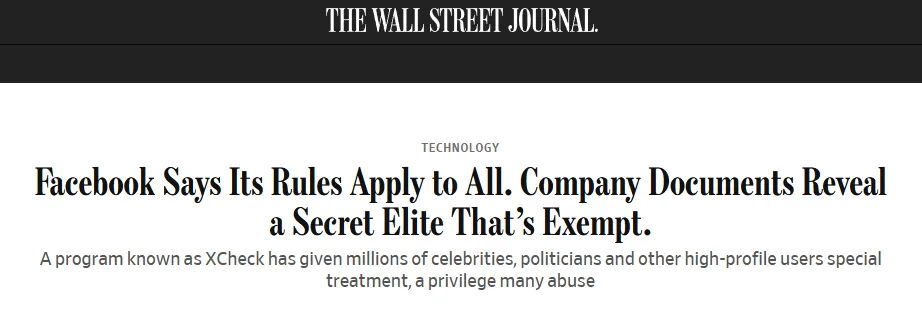
On Bluesky, someone argued that Meta “should know” to keep an eye on “big political accounts” like this, which is nice in theory, but as I explained, Meta actually did that for years, in a program they called XCheck, which flagged high-profile accounts (i.e., “big political accounts”) for secondary human review before any action was taken against them — exactly what this commenter suggested. But.. when Frances Haugen leaked that to the WSJ, it was presented as Facebook having “a secret elite that is exempt” from its rules.

There’s even a movie in the theaters right now, by Aaron Sorkin, with this as one of the subplots.
Damned if you do, damned if you don’t.
But the biggest reason I don’t think this was deliberate is because… why would anyone think it would help in any way? Of all the accounts the Trump admin might want to ban, does anyone actually think they would suggest this one account on Instagram of a protest that was already happening across the country, with people involved who would immediately notice the account was taken down and use other means to get the word out?
If the Trump admin were actually telling Zuck to take down accounts, you’d expect it to be happening a lot more frequently, to much more meaningful accounts, in ways that wouldn’t so immediately draw way more attention to the original account. The story just doesn’t hang together in any sensible way.
Still, some will argue, perhaps it wasn’t the White House reaching out. Perhaps it was just Zuck or a Zuck minion thinking “gosh I hate all these protestors, and now that we’re all in for Trump, let’s show these libs a thing or two….” While possible this seems incredibly hamfisted and unlikely, and generally not at all how these systems work.
Either way, if you think I’m hopelessly naive, and that this was obviously government intervention, or even just Zuck deciding on his own to show the protestors who’s the boss… the outcome doesn’t change. And what we do it about it doesn’t change. The intent barely matters here at all.
In either scenario the problem is that Zuck has too much power, and the answer should be to make sure Zuck has less power by moving to systems no single billionaire, no single politician, no single entity anywhere can control. Yes, that will involve some form of collective action. But it starts with you. If you are continuing to rely on such platforms yourself, then don’t whine about how Zuck might not have your best interests in mind.
We already know that.
Any plan that involves demanding billionaires become better people to make your life easier is destined to fail. Instead, we now have the power to build our own tools on our own systems that we control — and we can make them billionaire resistant, which makes them enshittification resistant. And then we don’t even have to worry about Zuck or Trump or Musk or anyone putting their fingers on the scale in a way that goes against our own interests.
But it only happens if people agree to stop giving those billionaires the power over us.
Whether Zuck or Trump or anyone had anything to do with deliberately taking down the No Kings account should be the least of our concerns. The fact that anyone is relying on a system where there is a central provider who can do that — by accident or not — is the underlying problem. Because the fact that a single provider can do it, means that eventually someone will try to pressure them to do it, even if that didn’t happen in this case. Or it will go down by accident at exactly the wrong moment. Either way, you avoid that by moving to systems where no single provider gets to make that call.
No kings is a great slogan, but it should apply to the people who control our communications infrastructure as well.